(*Title from the lyrics to Night Mime by Melanie Martinez)
First of all, I need to point out how pretty and sleek this blog is now. It was pretty and sleek before, but the new blog templates are super simple and aesthetically pleasing. I've been meaning to make this space cleaner and more professional looking for a while, especially since I'm not interested in making a static author site - I find them boring and dated, and I suspect most other readers do, as well.
That said, this page itself has been pretty static lately. Part of that is just me being the reclusive hermit I really am at heart and moping in a depressive state. I recently turned twenty-one and I always get weird and introspective around my birthdays. (Which is to say most of my days this month have been spent in bed, staring at the wall and musing about mortality and the human soul. Total downer, right?)
Another part of it is that I've been on an outlining kick, writing treatments and summaries for a bunch of books, along with designing covers and trying to hash out when I'm working on which projects.
I just finished revamping Blood of Midnight and publishing it under my adult pen name, Cosmo Knox. The main difference is that it has a new cover and a new name on it, but the material of the book is unchanged, aside from a new author note explaining the concept of the series. Essentially I decided that Dru's story from Blood of Midnight was complete in and of itself, despite the open ending, and I didn't want to write a direct sequel. Instead, each book in the series will be a new take on the same characters and scenarios, in the vein of the Legend of Zelda series.
In book two, Dru and Lucia will be boys, named Dru and Lucien, Vincent will be a Magister instead of a prince, and the Evernight curse will take a different form. The paranormal element also changes from vampires to sphinxes, which I'm excited about, since I feel like it's a more interesting, original mythology than vamps - although I do love hot boys with fangs. :)
That's not to say it's the same story repeated again - several aspects of both the world and characters are tweaked, but the plot always plays out a different way, with characters filling different roles. I've even considered making Dru the villain in a few of them... Book two in particular is going to play into a lot of different tropes and stories than what I explored in Blood of Midnight.
Some will be high fantasy while others are urban fantasy and paranormal romance... I may even write a contemporary slasher iteration of the story. (Scream vibes, anyone?)
Which is to say, each book is a standalone, and they can be read together or alone, and in any order.
Right now I'm editing the four original Lilac Jones Adventures stories to be republished as Beacon, the first in a trilogy of short story collections.
I have a cover to share, which is really pretty, neon, and hazy, but I'm holding it hostage for a while since I'm not done editing the stories. That said it should be out sometime this week.
In case you're wondering, that does mean there will be some fairly glaring changes to the stories before I republish them.
First of all, I wrote the first few when I was eighteen, and I'm just a way better writer and editor now.
Second of all, I want to spruce the books up for clarity and mine them for deeper material; mostly just developing characters and relationships further and showcasing who Lilac is as a person, outside of her adventures as a beacon. Also, when I wrote them I wanted them to be fast, fun, light stories that were kind of juvenile, and while they're still whimsical and entertaining, I did want to make them slightly more mature and display more of Lilac's intelligence and capabilities for the books to come. (I'm calling them Shine & Hex as of now, but they may change.)
I'll be updating the Lilac Jones tab at the top of the blog soon, but until then the old versions of the series will be there. Once I update it the page name will change to Beacon to match the new publication!
Beacon will contain the previous four stories with new editing and a few brand new vignettes added between them, while all the material in Shine and Hex will be new and never before published, and is yet to be written. The main bulk of my editing is updating the previous stories to match my current voice the the jump between books isn't too glaring, although there will be a time jump of half a year between the end of Beacon and the start of Shine.
I do plan on releasing other books set in this series in the future, and I have three other short story/novella series in the works right now that I want to focus on this year.
I'll be blogging more in the days to come - both about Beacon & those other projects, plus some craft stuff, so stay tuned! :)
***
You can follow me on Twitter here, or buy my books here...thanks for reading!
Showing posts with label self-publishing. Show all posts
Monday, 10 April 2017
Monday, 19 September 2016
5 Things You Should Know Before Self-Publishing
1) Your First Book Won't Be Your Big Break
Take a deep breath. Now exhale.
Your first self-published work probably won't launch you to the top of bestseller lists or turn you into an overnight rockstar. This is okay. It's normal. You are not a failure.
The market is overflowing with indie books at the moment, and that will not be changing anytime soon. Readers want to see that an author is dedicated to their calling and capable of producing multiple works sometimes before taking a chance on them. Chances are you might not see a huge jump in sales until after you publish your third or fourth work. That's okay. It's normal.
Focus on creating good art and nurturing other artists, and in time, you will succeed. You have to prove you have the chops to keep at it even if it seems like stormy waters at first.
Tips:
- Books 200 pages and longer tend to sell better. Your cover is pretty important, but a good cover is worthless without a blurb that can keep up with it.
- $2.99 is the best price point, but 99 cent deals do have their limited power.
- If you can afford a placement (I can't) Netgalley is a lifesaver, and will help your book find readers better than almost anything else. Even I use it to find books to read, and end up reviewing and rating a large amount of them on other sites.
- Writing an entire series to completion before publishing the first installment, so the reader has less wait time between books, is a genius idea, if you have the patience to carry it out.
2) You Need to Multitask
You can't just be a writer. You need to be an editor and a marketer, a cover artist and an agent, a website moderator and a social media guru, all while presenting a strong brand and personality. It seem impossible - supporting other writers and creators while maintaining an Instagram account while writing your next book while editing another manuscript while you format paperbacks and launch marketing endeavors. You will find your stride, though, I promise.
Sometimes this work can be overwhelming, sometimes it will feel like you are drowning. Turn off the wifi, pour a glass of wine, open a blank word doc, and go crazy. Or don't - open a new Chrome tab and binge on American Horror Story. You deserve it, you golden angel, you.
And when you're in a better place, and you feel like the superhero you are once more, get back to doing what you know you're meant to.
Tips:
- If social media makes you gag like me, it can be best to stick to one site and make good friends, so it feels like less of a chore to use it. Twitter has a great community of authors.
- Self-publishing forums like those on Reddit and Absolute Write will teach you everything, make you feel less alone, and save your ass ten times at least.
- People will tell you not to work on more than one project at a time: those people are boring and lack vision, but to each their own... I find multiple projects at once keeps me fresh, on my toes, and focused on what I'm doing. I tend to draft one project at a time while editing one or two others, and I'm constantly working on new outlines. I know it sounds overwhelming, but being able to jump from project to project and still feel productive might just be a godsend for you like it was for me - you do not want to feel trapped by your own art.
- Building a network feels like less of a chore when you're making friends and helping authors achieve their dreams as well. Make friends, do your best to support them and take a genuine interest. It makes this so much easier.
- Be yourself. And when I say this, I mean it less in the corny, 'They'll like you for who you are!' way, and more in a 'Don't be a fake, phony asshole!' kinda way. Don't be fake. Don't feel like you need to perform or change yourself to please others or move product. It will blow up in your face: nobody likes a fake bitch, not even when she's writing The Next Big Thing TM.
3) Focus on What Interests You
I've written a lot of books. I've put my heart and soul and blood and tears on paper (Shadows of Ourselves), let myself get lost in a pretty, captivating daydream (Souls of Salt & Seawater), and written simple, bubbly commercial novels, just for fun (Storm of Masks), and you know what I learned?
If you are working on a project that you love and believe in, a project that feels like a part of you, you will work faster. You will work better.
When I truly love one of my books, I'm more willing to champion it, more willing to put my stock and money and time behind it, and this work feels less backbreaking.
AKA, do your best to pick projects you will have fun with and see through to the end - don't force yourself to write something to an audience that you have no strong feelings for. A book you love will write itself, a book that isn't right for you will feel like torture to complete.
Tips:
- Let an outline or idea sit for a time before leaping on it, to see if it takes over your subconscious mind. If a world or character won't shut up, it's probably worth exploring.
- Do not ignore early warning signs, or you will end up scraping 30,000 words and having to start a book again from scratch. Or, worse, abandoning it entirely. It is not fun throwing out days worth of hard work, people.
4) Don't Lose Patience
Rome was not built in a day. If your work is out there, it will find readers. Somehow, some way. Sometimes it takes a shove, or a gentle nudge. Sometimes you have to let it find its own way. Just trust yourself and keep moving forward. Letting yourself stagnate and your muscles atrophy serves nobody. All authors have that one book that under-performs. Do not let it be the end of your art.
Tips:
- AT LEAST ONCE in your writing career, but probably way more times than that, you will find yourself sitting on the floor in your underwear, getting drunk and crying, wondering if you're throwing your life away. You may or may not try to ask your dead relatives for advice from beyond the grave. They won't give it to you, though, selfish villains that they are. This is normal. This is the stress of being a living, working artist. But you know why you got into this and you know what it means to you, so don't you fucking let your stress win. We've all felt like we were facing doomsday at one point or another, legacy or self-published, and those storms always pass. It doesn't matter if you're a first-time indie or the next Suzanne Collins with hype and a big six publisher and a movie deal at your back - you have undertaken a huge project, and you are allowed to have a human moment about it, okay?
- Sometimes you need to unplug your wifi box, turn off the lights, crawl into bed with a pizza pocket and a good book, and lose yourself. Sometimes you need to spend four days not writing, just watching an entire season of a TV drama in one sitting every day, in order to give your brain and soul a rest. This is alright, you are not awful and you are not a failure.
- Some books are a success right off the bat, others do not find an audience for years. The guy who wrote Moby Dick didn't get famous until after he died, and we all love that ugly ass white whale and the rugged sailors who hunt it now, don't we?
- You may stress eat an entire box of crackers, half a cake, ten greasy burgers, and an entire bottle of wine. It's part of the job: don't beat yourself up.
- Books go through many incarnations; a future edition with a new cover or marketing angle might do better, so never lose hope!
5) Have Fun
Don't worry if what you're trying is what other people are doing or if you don't fall enough into line with conventional wisdom. History has been made by those who left old paths behind and formed new ones!
At the end of the day you cannot force yourself to do something you don't want to do. If you have to ignore marketing to finish a book, do it. If you have to sacrifice social media followers to finish a project or you have to spend more time on each book than other authors do, so be it. Do whatever feels right for you - and whatever is effective. You're aiming for results, not another way to blend into the herd.
Once again: TRUST YOURSELF, and know that if you're having fun, you've gotta be doing at least something right.
Tips:
- Let inspiration take over. A few days before publishing Shadows of Ourselves, I took the book in a new direction at the last minute - changing the cover and pitch focus of the book. It turned out to be (at the time, though I think Divinity may have surpassed it by now) my most successful book yet. I was very weary of making changes like that so late in the process, especially since I'd shared the old cover widely, but it was worth it. I put out the book as an Urban Fantasy instead of a Paranormal Romance, and it was a very good idea, even though it scared me at the time. Don't be afraid to listen to your inner voice and follow your instincts. It pays off.
- Some days you will write 15,000 words in a day and gain twenty new followers and sell thirty books and feel like you're flying. Other days managing 500 words feels like pulling hairs from your head, and your zero sales so far do not help, and so you will end up on the couch rewatching Confessions of a Shopaholic because you have an insatiable crush on Hugh Dancy. It is all good. Don't be too hard on yourself.
- Remember that at the end of the day, life is a journey. My biggest goal in life used to be becoming an author. Once I actually became an author, I realized letting the people in my life know I love them and experiencing new things is vastly more important to me. Your work is not everything. You are not building the great wall or saving millions of lives or changing the world - you're telling a fun story. Go write your YA robot war manifesto complete with cheesy love triangle and chosen one trope and just have fun with it. You'll be okay.
***
Like my work? Buy my books!
Or, follow me:
Twitter.
Instagram.
Monday, 18 July 2016
The Return to Editing Hell - Also, Cake
I'm deep in the pits of editing hell, sorting through alternate characterizations and back stories and fictional family trees, so I can't take the time to write a super long blog post today.
Once I finish this round of edits I'm starting tonight I'll be writing another self-publishing know-how type post, though. Probably.
Right now I'm focused on making Divinity the most fun adventure I can. . .
Once I finish this round of edits I'm starting tonight I'll be writing another self-publishing know-how type post, though. Probably.
Right now I'm focused on making Divinity the most fun adventure I can. . .
I've been eating this Dairy Queen ice cream cake while I obsessively edit and tweak the cover design. I think it's pretty fun, so far. It's got angels and monsters and hot boys and Devil Wears Prada-ish subplots. I feel like readers will be able to tell I'm only scratching the surface of things with this book, and the questions they're left with will lead them onto book two.
Because, damn, book 2. Things are going to go a little insane.
I don't think I realized when I started writing these how action-driven the series was going to be, overall, and I'm having fun coordinating fight scenes and stuff. Every time I try to write a romance I inevitably end up throwing in battle scenes, because I can't help myself.
I just have to ask myself, if my book doesn't have elaborate fight scenes then am I doing my inner six year-old, who lived on Dark Angel and Kill Bill and Pirates of the Caribbean, any justice at all?
Nope. So, more swords.
It seems like a pretty simple solution to all my problems.
One thing I really love about Divinity and the Seraph Chronicles in general is I'm letting myself play around with pov and verb-tense. I know that's not something everyone loves, but I feel like when it's done right it's actually fairly enjoyable.
Right now there is an epilogue I'm thinking of taking out, even though I like it quite a lot - I feel like it fucks with the momentum of the book.
Since I'm too lazy to search for a good, non-spoiler-y quote right now, I'll leave you with a bit of the music I've been listening to while writing this bad boy;
Friday, 8 July 2016
Things I wish I Knew Before I Started Self-Publishing
There are plenty of posts like this out there, and plenty more that teach you how to self-publish piece by piece. I don't feel the need to make too many in-depth tutorials about that, because there are people who have already said those things better than I can.
There are also certainly authors who have been both writing and self-publishing for much longer than me. I've been writing for nearly nine years now, but I've only been publishing since 2014--first, writing erotic romance under a pen name, and later, the young adult and new adult books I write and publish now as Apollo Blake. On July 29th I'm putting out my first New Adult paranormal romance with erotic aspects in it as Cosmo Knox to separate it from the more tame books. So while I do feel confident giving publishing advice and guidance, I'm also aware that there are authors out there with much more in their repertoire to share than I have.
If anything, the most advice I have to offer is about graphic design (I do have some cover design tutorials planned for the future) but there are quite a few thing I wish I'd known when I started self-publishing, and I find it fascinating to hear about other writer's processes anyway, so I figured I would share them for any beginners out there.
Writing your next book is more important than any kind of social media marketing you can do.
Social media followers aren't necessarily book-buyers. Having a large number of followers doesn't guarantee success or sales, and relying on them too much as opposed to producing more product will hurt you in the long run. It's good to get the word out there, but another book that's produced with care and good craft has more push behind it at the end of the day than a tweet that gets 15 minutes of attention.
This isn't to say social media is useless; it can lead to increased sales, but it's much more common for a new book to spur on sales than it is for one of your tweets or blog posts to be one of the few that goes viral. Sure, a new social media post might get you some more sales, but a new book is almost guaranteed to.
You can make good book covers yourself, but you have to be honest with yourself.
Buy a graphics program like Photoshop or Paint Tool Sai. (I use Sai, because I like it best, but it's not really meant for photo-manipulation.) If you can afford it, a graphics tablet. (I like Wacom.)
Now learn to use them. Learn by doing. You can be surprised how purely awesome you can get at developing new skill-sets when you have the internet at your disposal. Learning new languages and instruments and stuff like graphic design or how to build furniture gets much easier. Develop an eye for good stock and look at photo-manipulation tutorials and learn how to create new effects. Improvise using the tools in the program you like and you'll develop both a style and a useful eye for aesthetic and emotion in imagery, over time. It helps to watch a lot of video tutorials and look at which kind of covers you like, observe how other editors place things and how they adjust colors. There is a wealth of both speedpaints and tutorials on Youtube that are not only amazing, but also entertaining as hell.
Eventually you'll be producing high-quality covers and saving costs on cover design by doing it yourself while getting just as good a product, but you have to be honest with yourself; evaluate your art and question how it stands up against other authors, compare it to the covers on bestselling books. Learn about what draws the reader eye and what people like in visual imagery, learn about colors and how certain aesthetics evoke a certain emotion, look at other covers in that genre. You can't learn design if you can't see where you error and learn to improve, but it is both fun and worth it.
I have never taken a professional design course, everything I know about image editing I learned myself, and (not to brag) I think I've created some very pretty book covers:
You can find good stock on Canva for a dollar an image, Pixabay and sites like it have free commercial-use stock, and you can even find cool textures and stock on DeviantArt that creators put out for free commercial use. (Always be sure to read stock and resource rules! I tend to use DA for textures and little else.)
Reviews aren't always an indication of sales.
I have some books that have four- and five-star reviews that don't sell as many copies as my books with zero. Publishing is a weird industry, and while reviews (both positive and negative) definitely help, they don't always have an affect, or, when they do, a large one. My title with the best sales has zero reviews and has still become my top earner. Don't sweat it if your book doesn't get reviews straight off the bat; a quality product will still draw sales regardless.
It's better to write the book only you can write than try to fit into genre norms.
Genres are meant to indicate certain aspects of your work to readers and buyers, not to dictate every aspect of the content itself. Allowing genre or age group to force your writing into a box where you strive to hit genre trends will hurt you and your career. More importantly, it will usually negatively impact your creativity and take the fun out of writing. Don't sacrifice aspects of your art in order to turn your book into a clone of its peers. Allow your original voice to shine through. It's easy to start thinking of your books as solely commercial ventures once you become your own publisher, but don't lose sight of your unique artistic voice, because it will always strengthen the personality of your work.
It's good to have a backlist, even if waiting to publish is painful.
Waiting to put out a book you know is ready sucks, but you will always draw more readers putting out the books in a series closer to each other than you would putting out one book at a time. Even unrelated novels are more beneficial financially if they're put out closer together--readers want to binge, just like TV audiences do. Content consumers have big appetites all around. If you want to be prolific but don't want to waste time building up a backlist of long novels or simply don't have it, novellas are a fun way to put out titles faster without sacrificing story and quality, sort of a showcase of what you can do as an author, and a fun little reading experience on its own. Be warned, though--novella readers and novel readers tend to run in different crowds, so you can't always be confident in them following you over to longer works. There is a decent market for novellas, though, and they're both fun to write and useful for developing a stronger writing skill-set, just like short stories, but with a bit more meat on their bones.
The indie community has your back. Really, they do. For every author that seems like a living spam-bot just throwing their books at you, there are two more who are kind, thoughtful, talented, and creating good art. Give back. Spread the word, offer a helping hand, use word of mouth to help the careers of other indies. Put your money where your mouth is, so to speak.
Good enough isn't good enough. You should be striving to make each book you put out better than the last and deliver the best product you can. Always be looking for ways to improve on all aspects of production, be it voice, cover design, formatting, marketing, or more. You owe it to people buying your books to work as hard as you can to create an enjoyable, riveting experience.
Authors like Jennifer Ellision, Leigh Ann Kopans, and Nenia Campbell make really good art and put out books with production value (editing, cover-quality, prose, and formatting) that matches their traditionally-published peers.
Be honest with yourself with what you're putting out and do your best to improve it. It's not uncommon for me to release new editions of old books that I've given a firmer editing or a new cover because of how much I've learned since its initial release. That's another thing: no book left behind. You might think its too late to save a title in your catalog that didn't have the best cover or had a few odd quirks in the formatting, but it's next to nothing to give a book a new, better cover or another editing pass and tweak it to improve the overall quality, and it can rejuvenate an old title and bring in new sales. You might not think it matters, but it matters to people who will read that book in the future, so don't just strive to improve with new books--apply what you learn as you go to the old ones, too.
The number one cause of writer's block is putting too much weight on your own shoulders. Let's be honest for a minute, okay? You're not curing the zombie virus, you're not ending world violence, you're not building a helicopter or sailing across the ocean on a floating mattress--so take a deep breath and chill. At the end of the day no matter how much work goes into your book it isn't going to turn into some magic tome whose pages glow that cures diseases with just a touch and saves the world. You're just writing a book. Have fun with it, and try to make it fun for the reader. Accept that when it's done it's done, and move on to the next project.
You will always write faster when you're not writing something just because you feel like it's what you should be writing. What do you like in a story? If you love problematic kidnap romance (ahem, ahem) then don't force yourself to write worldly literary fiction, just 'cause it seems proper. If you like experimental lyrical prose, quit forcing yourself to slam out chick-lit novels that annoy you. If your favorite books are trashy paperback crime novels or formulaic fantasy romances that are fun to read at the laundromat, why are you writing dark magical realism and trying to be the next Neil Gaimon? It's not that hard to figure out that if you write what you love, you will love writing. Have fun and you'll get more done, that's my motto and I'm sticking to it.
To be clear, there can be a marked difference between reading tastes and writing tastes. I love reading memoirs, but whenever I try to write one of my own I cringe. I adore historical novels, but I think if I ever try to write one I'll rip my own hair out of my head. I like to read light, fluffy, breezy romance books to wind down after stressful work days, but whenever I try to write them I end up with really gritty, dark stories about, like, substance abuse and mental illness and abuse, but with werewolves and pixies running around in the background.
So, really, there's no accounting for your tastes as a writer--but you know you best. Do what you enjoy and leave the rest to other writers. Don't fight your voice, and you'll find writing regains its joy for you.
Water.
I'm not one of those people who thinks water is a cure-all, but get up right now and go take a drink of cold water and tell my it didn't clear your head and refresh you. I tend to keep a cup or bottle beside me as I'm writing, both because it's my favorite drink and because it's an excuse to get up and stretch my feet for a second. Most people don't consume enough water, so this one is really important to remember.
Raw Carrots.
...Now go make a coffee and get writing! (Or, if you like reading and wanna support me, you could check out my books, here!)
There are also certainly authors who have been both writing and self-publishing for much longer than me. I've been writing for nearly nine years now, but I've only been publishing since 2014--first, writing erotic romance under a pen name, and later, the young adult and new adult books I write and publish now as Apollo Blake. On July 29th I'm putting out my first New Adult paranormal romance with erotic aspects in it as Cosmo Knox to separate it from the more tame books. So while I do feel confident giving publishing advice and guidance, I'm also aware that there are authors out there with much more in their repertoire to share than I have.
If anything, the most advice I have to offer is about graphic design (I do have some cover design tutorials planned for the future) but there are quite a few thing I wish I'd known when I started self-publishing, and I find it fascinating to hear about other writer's processes anyway, so I figured I would share them for any beginners out there.
Writing your next book is more important than any kind of social media marketing you can do.
Social media followers aren't necessarily book-buyers. Having a large number of followers doesn't guarantee success or sales, and relying on them too much as opposed to producing more product will hurt you in the long run. It's good to get the word out there, but another book that's produced with care and good craft has more push behind it at the end of the day than a tweet that gets 15 minutes of attention.
This isn't to say social media is useless; it can lead to increased sales, but it's much more common for a new book to spur on sales than it is for one of your tweets or blog posts to be one of the few that goes viral. Sure, a new social media post might get you some more sales, but a new book is almost guaranteed to.
You can make good book covers yourself, but you have to be honest with yourself.
Buy a graphics program like Photoshop or Paint Tool Sai. (I use Sai, because I like it best, but it's not really meant for photo-manipulation.) If you can afford it, a graphics tablet. (I like Wacom.)
Now learn to use them. Learn by doing. You can be surprised how purely awesome you can get at developing new skill-sets when you have the internet at your disposal. Learning new languages and instruments and stuff like graphic design or how to build furniture gets much easier. Develop an eye for good stock and look at photo-manipulation tutorials and learn how to create new effects. Improvise using the tools in the program you like and you'll develop both a style and a useful eye for aesthetic and emotion in imagery, over time. It helps to watch a lot of video tutorials and look at which kind of covers you like, observe how other editors place things and how they adjust colors. There is a wealth of both speedpaints and tutorials on Youtube that are not only amazing, but also entertaining as hell.
Eventually you'll be producing high-quality covers and saving costs on cover design by doing it yourself while getting just as good a product, but you have to be honest with yourself; evaluate your art and question how it stands up against other authors, compare it to the covers on bestselling books. Learn about what draws the reader eye and what people like in visual imagery, learn about colors and how certain aesthetics evoke a certain emotion, look at other covers in that genre. You can't learn design if you can't see where you error and learn to improve, but it is both fun and worth it.
I have never taken a professional design course, everything I know about image editing I learned myself, and (not to brag) I think I've created some very pretty book covers:
You can find good stock on Canva for a dollar an image, Pixabay and sites like it have free commercial-use stock, and you can even find cool textures and stock on DeviantArt that creators put out for free commercial use. (Always be sure to read stock and resource rules! I tend to use DA for textures and little else.)
Reviews aren't always an indication of sales.
I have some books that have four- and five-star reviews that don't sell as many copies as my books with zero. Publishing is a weird industry, and while reviews (both positive and negative) definitely help, they don't always have an affect, or, when they do, a large one. My title with the best sales has zero reviews and has still become my top earner. Don't sweat it if your book doesn't get reviews straight off the bat; a quality product will still draw sales regardless.
It's better to write the book only you can write than try to fit into genre norms.
Genres are meant to indicate certain aspects of your work to readers and buyers, not to dictate every aspect of the content itself. Allowing genre or age group to force your writing into a box where you strive to hit genre trends will hurt you and your career. More importantly, it will usually negatively impact your creativity and take the fun out of writing. Don't sacrifice aspects of your art in order to turn your book into a clone of its peers. Allow your original voice to shine through. It's easy to start thinking of your books as solely commercial ventures once you become your own publisher, but don't lose sight of your unique artistic voice, because it will always strengthen the personality of your work.
It's good to have a backlist, even if waiting to publish is painful.
Waiting to put out a book you know is ready sucks, but you will always draw more readers putting out the books in a series closer to each other than you would putting out one book at a time. Even unrelated novels are more beneficial financially if they're put out closer together--readers want to binge, just like TV audiences do. Content consumers have big appetites all around. If you want to be prolific but don't want to waste time building up a backlist of long novels or simply don't have it, novellas are a fun way to put out titles faster without sacrificing story and quality, sort of a showcase of what you can do as an author, and a fun little reading experience on its own. Be warned, though--novella readers and novel readers tend to run in different crowds, so you can't always be confident in them following you over to longer works. There is a decent market for novellas, though, and they're both fun to write and useful for developing a stronger writing skill-set, just like short stories, but with a bit more meat on their bones.
Other authors are your friends and you should be giving back.
The indie community has your back. Really, they do. For every author that seems like a living spam-bot just throwing their books at you, there are two more who are kind, thoughtful, talented, and creating good art. Give back. Spread the word, offer a helping hand, use word of mouth to help the careers of other indies. Put your money where your mouth is, so to speak.
Making good art is better than making acceptable art.
Good enough isn't good enough. You should be striving to make each book you put out better than the last and deliver the best product you can. Always be looking for ways to improve on all aspects of production, be it voice, cover design, formatting, marketing, or more. You owe it to people buying your books to work as hard as you can to create an enjoyable, riveting experience.
Authors like Jennifer Ellision, Leigh Ann Kopans, and Nenia Campbell make really good art and put out books with production value (editing, cover-quality, prose, and formatting) that matches their traditionally-published peers.
Be honest with yourself with what you're putting out and do your best to improve it. It's not uncommon for me to release new editions of old books that I've given a firmer editing or a new cover because of how much I've learned since its initial release. That's another thing: no book left behind. You might think its too late to save a title in your catalog that didn't have the best cover or had a few odd quirks in the formatting, but it's next to nothing to give a book a new, better cover or another editing pass and tweak it to improve the overall quality, and it can rejuvenate an old title and bring in new sales. You might not think it matters, but it matters to people who will read that book in the future, so don't just strive to improve with new books--apply what you learn as you go to the old ones, too.
Don't take yourself too seriously.
The number one cause of writer's block is putting too much weight on your own shoulders. Let's be honest for a minute, okay? You're not curing the zombie virus, you're not ending world violence, you're not building a helicopter or sailing across the ocean on a floating mattress--so take a deep breath and chill. At the end of the day no matter how much work goes into your book it isn't going to turn into some magic tome whose pages glow that cures diseases with just a touch and saves the world. You're just writing a book. Have fun with it, and try to make it fun for the reader. Accept that when it's done it's done, and move on to the next project.
Seriously, write the book only you can write.
You will always write faster when you're not writing something just because you feel like it's what you should be writing. What do you like in a story? If you love problematic kidnap romance (ahem, ahem) then don't force yourself to write worldly literary fiction, just 'cause it seems proper. If you like experimental lyrical prose, quit forcing yourself to slam out chick-lit novels that annoy you. If your favorite books are trashy paperback crime novels or formulaic fantasy romances that are fun to read at the laundromat, why are you writing dark magical realism and trying to be the next Neil Gaimon? It's not that hard to figure out that if you write what you love, you will love writing. Have fun and you'll get more done, that's my motto and I'm sticking to it.
To be clear, there can be a marked difference between reading tastes and writing tastes. I love reading memoirs, but whenever I try to write one of my own I cringe. I adore historical novels, but I think if I ever try to write one I'll rip my own hair out of my head. I like to read light, fluffy, breezy romance books to wind down after stressful work days, but whenever I try to write them I end up with really gritty, dark stories about, like, substance abuse and mental illness and abuse, but with werewolves and pixies running around in the background.
So, really, there's no accounting for your tastes as a writer--but you know you best. Do what you enjoy and leave the rest to other writers. Don't fight your voice, and you'll find writing regains its joy for you.
Also, read these books:
2k to 10k by Rachel Aaron, Let's Get Digital by David Gaughran, On Writing by Stephen King, Writing Magic by Gail Carson Levine.
I will freely admit that I regularly reread sections of 2k to 10k every time I start drafting a new manuscript. The editing method she puts forth in that book also changed the way I edit forever, making it much more time-efficient and effective for strengthening my stories. And fun. I used it for Shadows of Ourselves and edited that book in record time, so I am never going back.
That's what I got, really. My other advice is basically drink lots of water and some coffee, take breaks from writing to walk around and breathe for a minute, and make lots of cool writing playlists on 8tracks to inspire you. Pinterest is also a life saver.
(You can see my endless pretty boards here, if you like nice pictures and magic and apartment porn!)
*Bonus; the best writing snacks you will ever discover!
Swiss Cheese Crackers:
I honestly don't know if these exist in the US or other countries, but if you live in Canada (at least on the East Coast) then you'll probably be able to find them, and let me tell you--I WOULD GIVE UP MY FIRSTBORN RAPUNZEL-STYLE FOR A LIFETIME SUPPLY OF THESE SWEET LITTLE MIRACLES. I can't tell you how many times I've crammed a box of these down my face while pulling off an eleven thousand words writing night. They never get old. These are the ones I pull out for long-haul, I'm gonna be here for twelve to fifteen hours writing fests.
PB & J on Toast.
I'm crying right now. The only thing better than pb & j is pb & j oN TOAST. Seriously, take a break to eat this and feel that godly peanut butter energy flow back through your body. Drink some water (or more coffee, if you roll like me) and hop back on the keyboard to watch the words fly.
Plain, Salted Crackers
Yeah, I admit it, sometimes I go two days without consuming anything but water, black coffee, and plain crackers. Am I a destitute London street urchin who sometimes steals away into the kitchen of a hipster cafe at night to get some brew? Does some tragic disease make it so I can only digest saltines? Nope and no way, my friend, it's just that sometimes the best thing to take the edge off is a crunchy cracker. And, also, sometimes, you work better when you're hungry. Obviously don't starve yourself, but it's okay to let yourself feel the edge of hunger sometimes, and you might just find it sharpens your mind for a bit and helps you get in touch with the psyche of your characters. Especially if you're writing like, angsty emotional scenes.
Plus, crackers are pretty good, either way.
Microwave Rice. (Bonus points if you also fry an egg or slice up cucumbers or mushrooms.)
If you want the warmth and heartiness of a big meal but not a lot of cooking time, because you've been running on fumes for hours and hours now and you just remembered you're a human being who needs food to survive, and not just words, then throw a cup of rice and a cup of cold water in a microwaveable dish with a teaspoon of butter and microwave it for 6 minutes, stirring at the 3 minute mark. 9 times out of 10 this makes perfect, delicious rice that's even better with a hot fried egg on top.
Water.
I'm not one of those people who thinks water is a cure-all, but get up right now and go take a drink of cold water and tell my it didn't clear your head and refresh you. I tend to keep a cup or bottle beside me as I'm writing, both because it's my favorite drink and because it's an excuse to get up and stretch my feet for a second. Most people don't consume enough water, so this one is really important to remember.
Raw Carrots.
You guys have no idea how much I love carrots. Seriously, grab one from the fridge, peel that shit with a peeler or a knife, and run it under cold water--tell me you don't feel like you just leveled up. They're just really refreshing, they perk you right up. They have the added benefit of being really crunchy.
Coffee.
I drink my coffee black. Am I a hipster? No, I am, sadly, just A Sucker With Bad Genes. For some reason if I put sugar and milk in my coffee I get really bad heartbearn and acid reflux. Sometimes I put cinnamon in there, though. Or ice cream. But usually it's black.
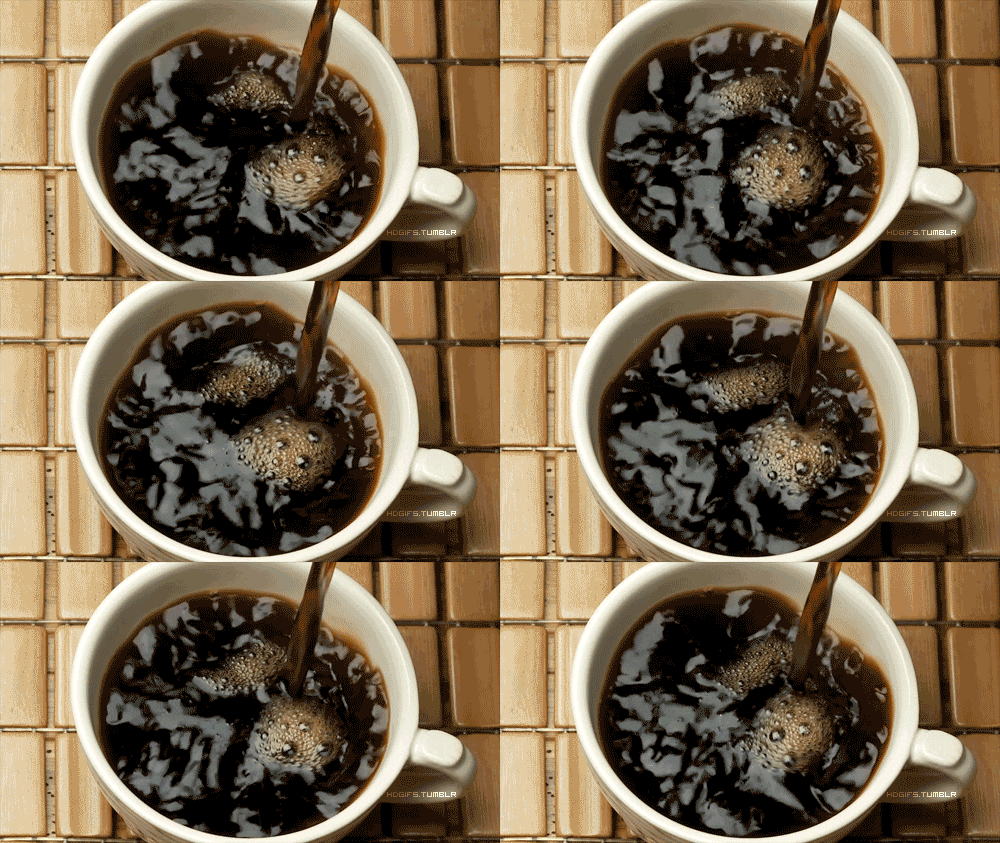
I will fully admit that I sometimes drink up to nine coffees a day. I will also freely admit that I added this to the list pure to add delicious coffee pictures.
...Now go make a coffee and get writing! (Or, if you like reading and wanna support me, you could check out my books, here!)
Sunday, 28 February 2016
Feeding the Rage Machine
I am working. Because I am a strong-willed, uneasily distracted author who knows when it's time to put words on the page.
Ok, I wish. Mostly I'm trying not to tear my hair out.
Rage is finished, and I'm moving onto edits. But I don't think a lot of people are going to love, or even like, this book. Why? It doesn't have a happily ever after. The ending is, if not sad, at least bittersweet. Bleak.
It's supposed to work as a standalone, and it does, but Myra as a character isn't done her journey, and she appears in Frenzy after the ending of Rage, and she appears in Maelstrom after the ending of Frenzy. Her story isn't over by the end of this book. I think readers who don't read the other books will be mad about that. But I think people who do read those books will appreciate it for what it is; a glimpse at some of the side characters of this world and at the Big Bad from Maelstrom.
So. That's where my head is. I, personally, love the thing. It's little and bleak and wordy, which is how I like them. Now - back to work.
Ok, I wish. Mostly I'm trying not to tear my hair out.
Rage is finished, and I'm moving onto edits. But I don't think a lot of people are going to love, or even like, this book. Why? It doesn't have a happily ever after. The ending is, if not sad, at least bittersweet. Bleak.
It's supposed to work as a standalone, and it does, but Myra as a character isn't done her journey, and she appears in Frenzy after the ending of Rage, and she appears in Maelstrom after the ending of Frenzy. Her story isn't over by the end of this book. I think readers who don't read the other books will be mad about that. But I think people who do read those books will appreciate it for what it is; a glimpse at some of the side characters of this world and at the Big Bad from Maelstrom.
So. That's where my head is. I, personally, love the thing. It's little and bleak and wordy, which is how I like them. Now - back to work.
Saturday, 9 January 2016
Something Meatless
So. The vegetarian thing is still going. I'm losing bits of my sanity every time someone in the house cooks meat, but I haven't cracked yet.
I woke up at twelve am and it's four in the morning now, so I should start working for a while, because I have a bunch of homework to do today as well, and I want to get my daily editing out of the way.
But first I have to go make something to eat. Something meatless. Ugh.
Thursday, 10 September 2015
The First Day of School: A Summary
So yesterday was my first day of school. I have to admit, I've been anxious about this for weeks. The end of summer was getting closer and I had no idea if I would be back in school daily or on the same program I'd been on last year, which was one where I basically home-schooled myself. I had to meet with the principal yesterday to figure out what would be happening.
I think a lot of people are surprised to find out I'm still in high school, and that always surprises me. It shouldn't, honestly, because I'm too old to still be in high school, so the assumption makes sense - but I'm not used to people taking me seriously enough to not immediately assume I'm an adult imposter. So why am I in high school? I failed two grades, among other things. I don't know how I failed grade one, so don't ask - I don't even know how it was possible, but it happened. In grade six I started skipping school a bunch, and had to repeat the year. I kept skipping after that, but it didn't get me in academic trouble until high school.
Anyway, I'm supposed to graduate this year. And I'm hoping I'll have all of my credits by the end of the first semester, so I won't even have to do this for the entire year - just half. But in order to accomplish that I needed to get on packages - the aforementioned home-schooling program - so I could work at my own pace and earn as many credits as possible.
The day started at 4:30am. I woke up in the dark, sweating, with my heart racing. I'd had another one of those serial killer dreams. I seem to be fixated on this idea this week, and I keep dreaming about it. It's because I watch too much Scream the tv show and eating cold pizza before I go to sleep, but it's giving me thrilling dreams and fantastic ideas, so I'm not complaining. Except for the whole awake at 4am part.
I was nervous as soon as I woke up. If I didn't get packages then I'd be spending the entire year in stuffy public school classrooms, the ones with the pastel painted cement block walls and desks with plastic 'wood finish' veneer. I was also nervous because if I did have to do that, it would be my last time ever being in high school - and if I get packages then that last time has already past. And that makes me sort of sad.
Public school raised me as much as my parents did. The reading corner in Ms. Genge's first grade class, trips to the library down the hall in her third grade class later on. I can remember my first crush - which, surprisingly enough, was on a girl - in Ms. Hachey's fourth grade home room. I remember pumpkin carving in the gym of my first middle school in grade 6, both times around, remember getting sent to the office for snapping at teachers, remember the first time someone told me I was their friend and I really believed them. I can remember ignoring our teacher lecturing us in social studies in the sixth grade so we could talk about Twilight and New Moon, and I can remember how after the longest detention of my life the same teacher who'd given it to me told me she thought I had what it took to be successful.
I remember my home room teacher in the second attempt at sixth grade, Mrs. Holden, lending me books and talking about my interests with me after class while I helped stack chairs - not because she had to, but because she was genuinely interested in talking with her students. I remember a teacher in the seventh grade giving me ten dollars to buy a cd at a school event, and I remember the first teacher who ever snapped at another student for using a gay slur, because one of his classmates could be gay. One of the first people who ever really made me believe I was talented and clever was my ninth grade English teacher, and I can still remember the vice principal of my high school keeping bins of snack bars and pastries and instant ramen just inside the door of his office so kids could grab a snack. I can remember spending music class holed up in the book room across the hall or the empty auditorium upstairs, pretending to learn guitar while we spent the entire hour talking, becoming friends.
This school system has been my home for 13 years now, and it will be that and a half by the end of this semester. It's a lot to say goodbye to, no matter how it ended.
I ended up sandwiched in the principal's office with him and a girl I've been friends with since the second grade, and we both ended up getting packages. So that's it, I sat in a high school classroom for the last time the first semester of the eleventh grade, and now I'm never gonna sit in one again.
I'll never eat lunch in the cafeteria again - or, more realistically, trudge uptown through snow for off-campus takeout - and I'll never spend break between each class gossiping in the chaos of a crowded hallway, or skip a class to go for coffee or hide out in the basement hallway near the pool, where everything smells like chlorine.
I'm strangely sad about it. And I'm excited, too, because now I can focus on work and graduating and writing. It's just odd to leave such a big chunk of my life behind. It helped me become who I was and learn a lot about the world, and it's sort of melancholy to watch it all slip away, even if I'm elated at the thought of a new chapter starting. And a new chapter is starting. Because I'm free by the end of this year. I can move wherever I want. I can do whatever I want. I can pursue my career without having to sacrifice time to school or other commitments that are forced on me. I'm, y'know, an adult.
And hey, the rest of the day was pretty good, too: I spent a lot of it sitting in the grass at the public park smoking with friends, but I also spent some time at an old playground called Rainbow Park that I love, and I got to hang out with some people I haven't seen in months because of life getting in the way.
So yeah, I don't know. It was wild, and nostalgic, and I'm a bit torn up about the fact that it's the last first day of my high school years. I'm a bit sad that it's my last first day with the friends I've been with since elementary school.
I'm set to spent an entire semester sitting around in my pajamas, mainlining coffees, writing, and squeezing in episodes of America's Next Top Model in-between bouts of obsessive school work. So I have a lot to do, and I'm gonna go get started, but I just needed to observe this strange sequence called time for a minute.
I think a lot of people are surprised to find out I'm still in high school, and that always surprises me. It shouldn't, honestly, because I'm too old to still be in high school, so the assumption makes sense - but I'm not used to people taking me seriously enough to not immediately assume I'm an adult imposter. So why am I in high school? I failed two grades, among other things. I don't know how I failed grade one, so don't ask - I don't even know how it was possible, but it happened. In grade six I started skipping school a bunch, and had to repeat the year. I kept skipping after that, but it didn't get me in academic trouble until high school.
Anyway, I'm supposed to graduate this year. And I'm hoping I'll have all of my credits by the end of the first semester, so I won't even have to do this for the entire year - just half. But in order to accomplish that I needed to get on packages - the aforementioned home-schooling program - so I could work at my own pace and earn as many credits as possible.
The day started at 4:30am. I woke up in the dark, sweating, with my heart racing. I'd had another one of those serial killer dreams. I seem to be fixated on this idea this week, and I keep dreaming about it. It's because I watch too much Scream the tv show and eating cold pizza before I go to sleep, but it's giving me thrilling dreams and fantastic ideas, so I'm not complaining. Except for the whole awake at 4am part.
I was nervous as soon as I woke up. If I didn't get packages then I'd be spending the entire year in stuffy public school classrooms, the ones with the pastel painted cement block walls and desks with plastic 'wood finish' veneer. I was also nervous because if I did have to do that, it would be my last time ever being in high school - and if I get packages then that last time has already past. And that makes me sort of sad.
Public school raised me as much as my parents did. The reading corner in Ms. Genge's first grade class, trips to the library down the hall in her third grade class later on. I can remember my first crush - which, surprisingly enough, was on a girl - in Ms. Hachey's fourth grade home room. I remember pumpkin carving in the gym of my first middle school in grade 6, both times around, remember getting sent to the office for snapping at teachers, remember the first time someone told me I was their friend and I really believed them. I can remember ignoring our teacher lecturing us in social studies in the sixth grade so we could talk about Twilight and New Moon, and I can remember how after the longest detention of my life the same teacher who'd given it to me told me she thought I had what it took to be successful.
I remember my home room teacher in the second attempt at sixth grade, Mrs. Holden, lending me books and talking about my interests with me after class while I helped stack chairs - not because she had to, but because she was genuinely interested in talking with her students. I remember a teacher in the seventh grade giving me ten dollars to buy a cd at a school event, and I remember the first teacher who ever snapped at another student for using a gay slur, because one of his classmates could be gay. One of the first people who ever really made me believe I was talented and clever was my ninth grade English teacher, and I can still remember the vice principal of my high school keeping bins of snack bars and pastries and instant ramen just inside the door of his office so kids could grab a snack. I can remember spending music class holed up in the book room across the hall or the empty auditorium upstairs, pretending to learn guitar while we spent the entire hour talking, becoming friends.
This school system has been my home for 13 years now, and it will be that and a half by the end of this semester. It's a lot to say goodbye to, no matter how it ended.
I ended up sandwiched in the principal's office with him and a girl I've been friends with since the second grade, and we both ended up getting packages. So that's it, I sat in a high school classroom for the last time the first semester of the eleventh grade, and now I'm never gonna sit in one again.
I'll never eat lunch in the cafeteria again - or, more realistically, trudge uptown through snow for off-campus takeout - and I'll never spend break between each class gossiping in the chaos of a crowded hallway, or skip a class to go for coffee or hide out in the basement hallway near the pool, where everything smells like chlorine.
I'm strangely sad about it. And I'm excited, too, because now I can focus on work and graduating and writing. It's just odd to leave such a big chunk of my life behind. It helped me become who I was and learn a lot about the world, and it's sort of melancholy to watch it all slip away, even if I'm elated at the thought of a new chapter starting. And a new chapter is starting. Because I'm free by the end of this year. I can move wherever I want. I can do whatever I want. I can pursue my career without having to sacrifice time to school or other commitments that are forced on me. I'm, y'know, an adult.
And hey, the rest of the day was pretty good, too: I spent a lot of it sitting in the grass at the public park smoking with friends, but I also spent some time at an old playground called Rainbow Park that I love, and I got to hang out with some people I haven't seen in months because of life getting in the way.
So yeah, I don't know. It was wild, and nostalgic, and I'm a bit torn up about the fact that it's the last first day of my high school years. I'm a bit sad that it's my last first day with the friends I've been with since elementary school.
I'm set to spent an entire semester sitting around in my pajamas, mainlining coffees, writing, and squeezing in episodes of America's Next Top Model in-between bouts of obsessive school work. So I have a lot to do, and I'm gonna go get started, but I just needed to observe this strange sequence called time for a minute.
Subscribe to:
Posts (Atom)
Fate, Strange Fate
I love PARADES. and Having Itchy Nails Tires me... And having hangnails is annoying. And having to clip my nails every three or four days i...
-
In case you all had missed it, a few days ago I published a new edition of Faces in Weeds on Kobo and Barnes and Noble , Apple Books , and ...
-
I am still writing things. I'm always writing things. Right now I'm actually editing things, which is mostly the same but also inc...
-
In the film Enemy at the Gates, a Russian sniper in WWII, Vasily Zaytsev, is transferred to the sniper division after he saves a comrade of ...